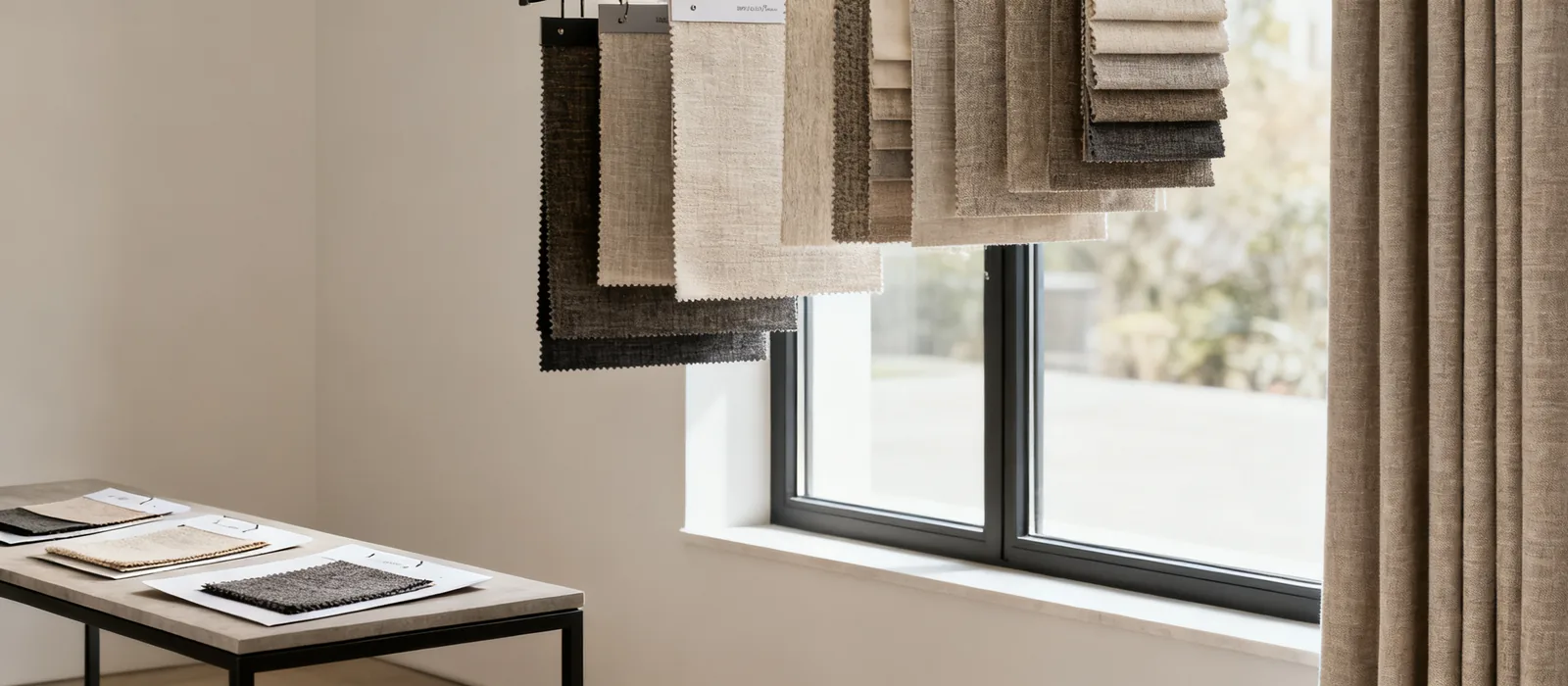
Windows, seats and the workroom table expose the same cloth family to different stresses. Name the stress before you ask for a test.
Application exposure landscape
Contact
Touch is the interior check people trust, and it is also easy to misread from a photograph. A drapery cloth is handled at the draw edge and at the hem. A seating cloth is handled across the face, often after someone has sat and stood. Handfeel words such as dry, crisp, brushed or slippery should be tied to the face you actually touched, including whether a finish was still on the memo.
Care sits inside contact. A curtain that is rarely washed and a cushion cover that goes to a domestic machine are not the same maintenance story. If dimensional stability matters, say whether the worry is a hem that rises after steaming, a cushion cover that shrinks, or a pattern that drifts after pressing. Pilling shows up where fabric rubs fabric, which is common on a loose back cushion and uncommon on a sheer that only meets a track.
Exposure
Daylight is the main exposure for curtain cloth. Colorfastness to light should be discussed with the orientation of the window and with whether the cloth is a face fabric or a lining that sits closer to the glass. A result from one specimen state does not travel to a different dye lot or a different finish. Shade approval under a lamp box and shade approval in the actual room can disagree, so write down which light you are using.
Seating exposure is mostly mechanical and chemical rather than weather. Abrasion resistance describes wear under a stated method. It does not describe a spill, a sunscreen cream or a cleaning chemical. If moisture is part of the room, say whether you mean a humid conservatory, a splash at a dining seat, or cleaning water. Liquid resistance and vapour movement are different properties, and most interior upholstery conversations need the cleaning question more than a waterproofing claim.
Processing
Cutting and joining decide whether a beautiful face can be made into the panel or cushion you have drawn. Usable width is the cuttable distance inside the selvedge, not the ticket width of the whole cloth. Pattern repeat, if the weave has one, consumes extra length at every cushion or drop. Railroaded upholstery can hide a width limit and can also turn a stripe the wrong way, so the cut direction belongs in the brief.
Seam slippage and tear strength become practical when the weave is open and the cover is tight. A drapery heading, whether pencil pleat, wave or a simple tab, loads the cloth differently from a boxed cushion corner. Ask how the edge behaves when it is sewn, and how it looks when it is draped over a hand. Roll inspection can note a shading barre that would read as a stripe across a wide sheer. Leave the workroom condition in the note: steam, adhesive, or a backing that might be added later and change the handle.
Selection tradeoffs inside this cloth family
Natural and synthetic fibres are not an environmental ranking on this page. A linen or wool drapery yarn is often discussed for dry handle and moisture response at a window. A polyester or viscose blend is often discussed when tensile strength, drying or a more stable shade is the priority. Either can fail if weave construction, finish and the room stress are ignored. Ask for fibre composition as a percent-by-mass declaration, and describe warp and weft separately when the face and the back do not feel the same.
Abrasion resistance and handfeel are separate targets. A durability reading needs the method, the end point and the specimen state. A comfort reading needs the physical memo: whether the face stays dry near 260 g/m², or whether a heavier seating cloth near 420 g/m² feels boardy after a backing is added. Pilling can rise while an abrasion figure still looks acceptable. One coupon does not retire the other question.
Tradeoffs to write into the brief, not a ranked catalogue
Choice
One side of the decision
The other side
Fibre
Natural yarn: touch, moisture and how the cloth relaxes in humidity
Synthetic yarn: strength, drying and a shade that may hold more evenly. Any environmental statement stays scoped to a named lot
Surface
Durability target: abrasion method, end point, and whether the specimen was the face cloth or a composite
Comfort target: handle after sitting, pilling where cloth rubs cloth, and whether a finish is still present after cleaning
Supply path
Stock colourway: confirm the current shade band, the lot and whether a repeat length is actually on hand
Custom colour: a lab dip, then a shade approval, then a bulk standard. A memo is not a bulk approval
Backing
Uncoated weave: usable width, yarn count and seam slippage of the cloth itself
Coating or lamination, if someone proposes it: coating add-on, adhesion or peel, and the specimen after flexing. That construction is different from a plain drapery cloth
Limits that stay in force: this site does not publish a mill GSM, a certificate number or a test-house pass. A useful comparison still names mass per unit area in g/m², usable width in centimetres inside the selvedge, and composition. An example of a question, not a JAB ANSTOETZ specification, is whether an unseamed panel needs more than 140 cm of usable width, or whether a sheer near 90 g/m² can carry the heading without a separate lining. Roll length in metres is an order field. It is unknown here until a supplier states it for a lot. Yarn linear density, in denier or dtex, must not be rewritten as a cotton count unless the memo names the system.
Describe the use environment
Daylight, sitting contact and the cut direction make a curtain or upholstery brief specific.